
Rooms That Stay Comfortable Year-Round
Ceiling Fan Installation in Avondale for bedrooms, living areas, and covered porches that need improved air circulation
Ceiling fans stop working efficiently when mounting hardware fails, when existing electrical boxes aren't rated for the dynamic load of a rotating motor, or when control wiring doesn't support variable speed functions. HPM Electric installs ceiling fans with proper electrical support and code compliance in Avondale and throughout Delaware County, addressing both new installations and replacements where previous fans vibrated, wobbled, or overloaded insufficient mounting systems. Professional installation in the area's residential communities requires fan-rated electrical boxes secured to structural framing, not standard fixture boxes that can't handle the rotational stress and weight of a spinning fan assembly.
The installation begins with confirming that the electrical box is fan-rated or replacing it with an approved pancake box or ceiling fan brace that spans between joists, running control wiring for single-speed, multi-speed, or remote-controlled operation, mounting the fan bracket to the box, connecting motor and light kit wiring according to manufacturer specifications, balancing blades if necessary, and testing all speed settings and directional controls. Homes built before fan-rated boxes became standard often have lightweight octagon boxes that flex under load, and these must be replaced before any fan installation proceeds.
Request a detailed estimate that includes electrical box inspection and any structural reinforcement your ceiling requires.
Our Services
What You Notice Once Fan Installation Is Finished
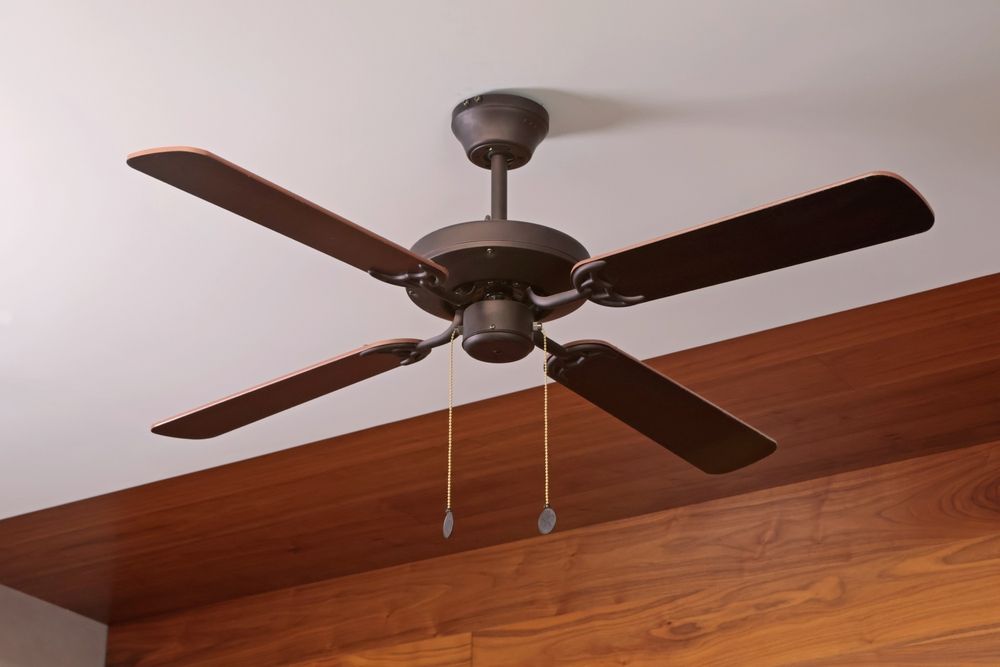
Fan-rated electrical boxes are secured directly to ceiling joists or to expanding braces that span between joists, and this structural support eliminates the wobbling and vibration that occurs when fans are mounted to undersized fixture boxes. Control wiring is run for the specific functions you've selected, whether that's wall-mounted speed controls, pull-chain operation, or wireless remote systems that adjust speed and direction without additional wall switches.
After installation, you'll notice consistent air movement that reduces reliance on heating and cooling systems, elimination of wobbling or humming from improperly mounted units, and reliable operation of all speed settings and light functions. Reversible motor direction allows you to push warm air down in winter and pull cool air up in summer, and properly balanced blades rotate smoothly without the vibration that indicates mounting or assembly problems.
Vaulted or sloped ceilings require angled mounting kits that keep the fan level while accommodating the ceiling pitch, and rooms with low clearance benefit from hugger-style fans that mount flush to the ceiling instead of using downrods. Light kits can be integrated during installation or added later if wiring is configured to support them, and smart-compatible fans require neutral wiring at the switch box for proper operation.
Answers to Frequent Service Questions
Homeowners in Avondale and surrounding Delaware County areas typically ask these questions before fan installations begin.
What makes an electrical box fan-rated?
Fan-rated boxes are reinforced to handle dynamic loads and secured directly to structural framing with heavy-duty fasteners, unlike standard fixture boxes that support only static weight and can't withstand rotational stress from spinning fan motors.
How do I know if my existing box needs replacement?
If the box moves when you apply pressure, if it's attached only to drywall, or if it's a lightweight plastic octagon box, it must be replaced with a fan-rated box before installation proceeds.
Why does fan direction matter?
Counterclockwise rotation in summer pulls cool air up and creates a breeze effect, while clockwise rotation in winter pushes warm air down from the ceiling to improve heating efficiency.
What ceiling height works best for fan installation?
Standard eight-foot ceilings require hugger-style fans, nine-foot ceilings accommodate short downrods, and higher ceilings need longer downrods to position blades seven to nine feet above the floor for effective air circulation.
How does control wiring affect fan operation?
Single-speed fans need basic switch wiring, multi-speed fans require three-wire control circuits, and remote-controlled fans need constant power at the fan with switching handled by the receiver module inside the canopy.
HPM Electric ensures that every fan installation includes proper structural support, compliant wiring, and functional testing across all speed and directional settings. Contact our team to schedule an inspection of your ceiling box and discuss fan options that match your room dimensions and control preferences.